


Over the last few years, few concepts have generated as much excitement as Artificial Intelligence.
Yet despite all the noise around prompts, models, and chatbots, the most important shift happening inside the industry today is neither larger models nor more powerful prompts.
It is the movement from prompt engineering to context engineering.
This shift matters because the next generation of software will not simply answer questions. Rather, they will perform work.
These systems are increasingly referred to as agentic systems or AI agents.
And while many founders are already experimenting with tools such as ChatGPT, Claude, Gemini, Cursor, Copilot, and OpenAI’s Operator, only a few understand what actually separates a useful AI assistant from a true agentic workflow.
Understanding that distinction is becoming important because every company will soon be evaluating whether a process should remain human-driven, software-driven, or agent-driven.
Before we discuss context engineering, retrieval systems, MCP servers, memory architectures, and agent orchestration, we first need to understand what people mean when they say «agent.»
First, Context. Not Context Engineering
One of the most common mistakes founders make when approaching AI is assuming that agents are simply large prompts connected to powerful models.
In practice, most successful production systems look very different.
According to entrepreneur and HumanLayer founder Dexter Horthy, after interviewing more than one hundred founders, engineers, and AI builders, a surprising pattern emerged: The best production agents were often not particularly agentic at all.
Instead of autonomous systems making dozens of independent decisions, most successful implementations looked remarkably similar to traditional software.
They simply inserted language models into specific places where human judgment was previously required.
This is important to note because much of the early excitement around agents was based on a vision that looked something like this:
A user gives an objective.
The AI plans every step.
The AI executes every task.
The AI monitors progress.
Then the AI completes the objective without supervision.
While technically possible, builders quickly discovered that this approach rarely produces reliable outcomes. Long-running autonomous workflows tend to accumulate errors.
Context windows become bloated.
Instructions become diluted.
Reliability deteriorates.
Costs increase.
And eventually, many teams find themselves spending hours debugging an agent that could have been replaced by a thirty-second script.
As Horthy humorously explains, one of his first experiments involved building a DevOps agent capable of compiling software projects automatically.
After several hours of refining prompts, adding instructions, and correcting mistakes, he realized he had effectively recreated a shell script that could have been written in less than two minutes.
The lesson here is simple: Not every problem requires an agent.
And understanding this may be the single most important concept founders learn before investing heavily in AI initiatives.
What «Agentic» Actually Means
When most people hear the word agent, they imagine an AI operating independently.
But the reality is more nuanced. An agent is simply software that uses a language model to make decisions within a workflow.
And that workflow might involve:
- Reading customer emails
- Classifying support tickets
- Approving invoices
- Updating CRM records
- Monitoring infrastructure
- Reviewing legal documents
- Managing software deployments
The AI itself is not the product; the workflow is. The model merely becomes a decision-making component inside that workflow. Viewed through this lens, agents start to resemble traditional software architecture.
Inputs arrive. Logic executes. Actions occur, and outputs are generated.
The only difference is that some of the decision points are now powered by language models instead of deterministic code.
This explains why many experienced developers are increasingly highlighting that agents are software.
And that like all software, they succeed or fail based on architecture, reliability, state management, and system design.
The Rise of Agentic Workflows
This brings us to a concept founders should care about far more than agents themselves: Agentic workflows.
An agentic workflow is a business process where language models participate in accomplishing a goal.
But more importantly, this does not mean the AI controls everything.
In fact, the most successful systems typically combine traditional software, human decision-making, and AI reasoning into a single workflow.
Consider a software deployment pipeline. Historically, the process might look like:
Code → Testing → Approval → Deployment
An agentic workflow might instead become:
Code → Testing → AI Review → Human Approval → AI Deployment Recommendation → Deployment
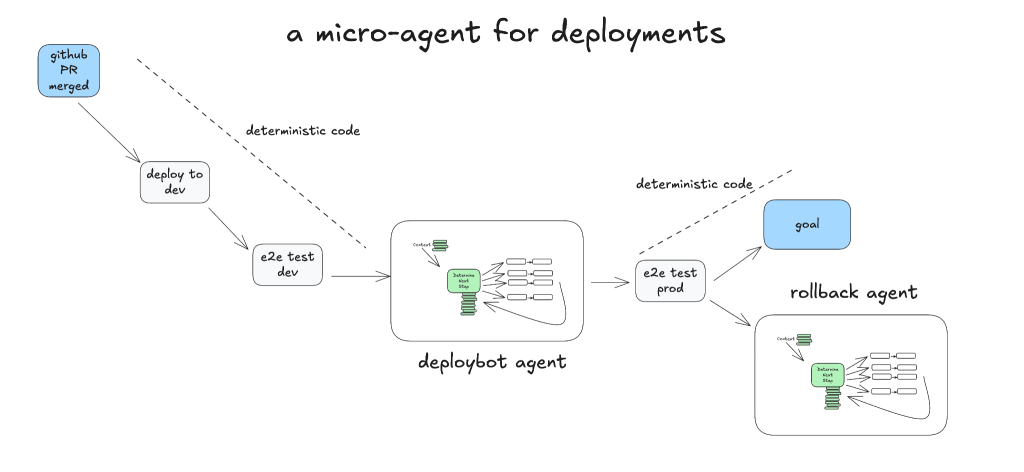
Most successful Agentic AI workflows look
like traditional software architecture.
Notice the AI is not replacing the workflow. It is augmenting specific decision points.
This approach offers advantages, including higher reliability, better auditability, lower costs, and easier maintenance
For founders, this distinction is important because many outsourcing, automation, and digital transformation initiatives over the next few years will be built around agentic workflows rather than fully autonomous agents.
Read also: 10 Things You Should Know About the OpenAI vs Elon Musk Legal Battle
Why Prompt Engineering Is Dying
For much of 2023 and 2024, AI education revolved around prompt engineering. Entire courses emerged teaching people how to write perfect prompts.
Social media filled with prompt libraries.
Founders competed to discover magical prompt templates that could unlock better outputs from ChatGPT, Claude, or Gemini, and for a while, this made sense.
Prompts were the only part of the system most people could see.
But as businesses began deploying AI into real workflows, something became obvious:
Two companies could use the exact same model and the exact same prompt yet achieve wildly different outcomes. Why? Because prompts were only one piece of a much larger puzzle.
The real differentiator turned out to be context. The model itself was rarely the problem. The information being fed into it was.
This realization sparked a shift that has quietly become one of the most important ideas in modern AI development: Context Engineering.
What Is Context Engineering?
At its simplest, context engineering is the practice of ensuring that an AI model receives exactly the information it needs, at exactly the moment it needs it.
Not more. Not less. Just enough.
Most builders instinctively assume that larger context windows solve this problem.
If a model can accept two million tokens, why not simply provide everything? The answer is reliability.
While modern models can technically process enormous amounts of information, successful AI builders have repeatedly found that smaller, cleaner, more focused contexts tend to produce better outcomes.
It makes sense. More information is not always more useful; often, it simply creates noise.
Large Language Models suffer from the same problem. Now the challenge is no longer generating answers.
The challenge is deciding what information deserves to enter the model’s attention in the first place.
The New Rule of Agent Building
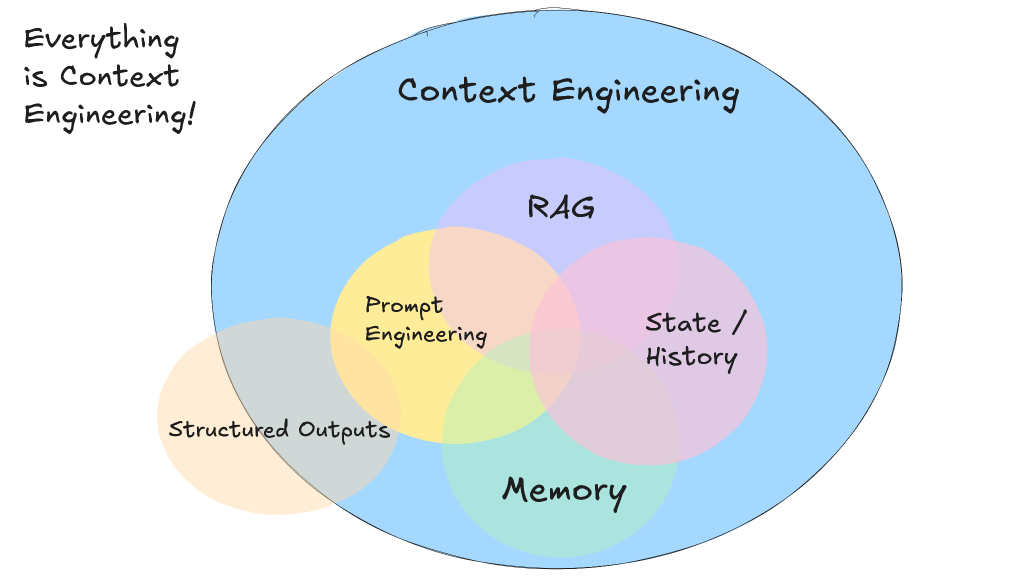
One of the most useful observations from the HumanLayer team’s research is remarkably simple: Everything in agent development is context engineering.
Prompts are context.
Memory is context.
RAG is context.
Conversation history is context.
Tool results are context.
User profiles are context.
Business documents are context.
Every technique currently being used to improve AI performance is ultimately an attempt to answer a single question: How do we get the right tokens into the model at the right time?
This is a subtle but important shift in thinking.
Instead of asking «How can we write a better prompt?»
Developers increasingly ask, «How can we construct a better context?»
The second question usually produces far better systems.
Context Engineering Is Becoming a Business Advantage
Needless to say, this shift carries significant implications for outsourcing founders.
Historically, software projects were evaluated based on:
- Features
- Functionality
- Performance
- User experience
Agentic systems introduce a new consideration: Information design.
Businesses must now think about:
- Where organizational knowledge lives
- How data is structured
- Which systems hold truth
- How workflows generate context
- How information moves between agents
And since in many cases AI adoption exposes organizational weaknesses that already existed, i.e., siloed knowledge, this is the reason why many new digital transformation initiatives increasingly begin with knowledge architecture rather than AI deployment itself.
Before businesses can build reliable agents, they often need to organize the information those agents depend upon, bringing us to the next major concept every founder should understand: Memory.
Since the easiest way to visualize all of these concepts is not as a list, but as a stack, here’s the chain of Agentic AI concepts very briefly from the lowest to the highest level of the stack.
LEVEL 1: The Raw Material
Tokens
The basic unit of language that an LLM processes. Every prompt, response, document, memory, tool call, and piece of code eventually becomes tokens.
Think of it this way: while computers run on bits. LLMs must transform textual input mathematically into tokens they can understand and run on.
Understanding tokens means understanding the techniques that AI models use to handle semantic representations of data and perform searches efficiently even at scale.
LEVEL 2: Prompting Era
Prompt Engineering
This is the art of crafting instructions to get useful outputs.
Examples:
- «Write a blog post using this.»
- «Generate a React component to do that.»
- «Summarize this document.»
This dominated 2023, but eventually, people realized that better prompts alone do not create reliable systems, which led to the next phase.
LEVEL 3: Context Engineering
This is arguably the most important concept in AI right now.
Context Engineering
Instead of asking «How do I write a better prompt?»
The goal becomes, «How do I feed the model better information?»
This involves:
- RAG
- Memory
- State
- MCP
- Tool access
- Context compaction
- Agent orchestration
According to people like Andrej Karpathy, context engineering is replacing prompt engineering as the central discipline of AI application development.
LEVEL 4: The Context Stack
These are components of context engineering.
State / History
Well, state is how agents and models represent what happened during the current task.
For example, if a user asked for a file, an agent searched and then found the document and generated an answer. This sequence becomes state.
Memory
Memory is Information preserved across tasks in AI workflows.
While State accounts for what is happening in the present, Memory is how models and context engineers understand what happened before.
In other words, memory is what we talk about when we talk about context compaction.
RAG
Stands for Retrieval-Augmented Generation.
Instead of stuffing everything into context, the technique was developed as a way for LLMs to retrieve new information from a specified set of documents, allowing them to use domain-specific or updated information that is not available in the training data.
Context Compaction
As conversations with agents became longer, token costs rose, and accuracy fell.
To combat this, developers used the technique of asking agents to summarize important details of their tasks; in other words, compressing previous information into a separate document.
This document can then be read by other agents or sub-agents to understand previous contexts important for present tasks.
LEVEL 5: Tool Use
In Agentic workflows and developer ecosystems, ‘tool’ refers to the equivalent of API endpoints.
It is the contract between your MCP server and the model.
They describe what the connector can do, how to call it, and what data comes back.
Structured Output
This refers to the result of a tool call, which is usually JSON instead of natural language text.
JSON stands for JavaScript Object Notation.
MCP Servers
Stands for Model Context Protocol.
MCP is an open specification for connecting large language model clients to external resources using tools.
An MCP server exposes tools that a model can call to do work.
LEVEL 6: Agents
AI Agent
An AI Agent is a piece of code connected to any large language model that can:
- reason
- use tools
- observe results and
- take another action
General-Purpose Agent
Most early agents were narrow. For example, they could only perform customer support or other specialized roles.
General-purpose agents can perform many different categories of tasks as opposed to specializations.
For examples:
- research
- planning
- scheduling
- Communication
- coding
- scheduling
- operations
- automation
All in one agent.
This was where projects like OpenClaw began to emerge.
Coding Agent
A specialized agent specifically tuned for software development tasks.
Examples include Codex, Claude Code.
LEVEL 7: Agent Infrastructure
Sub-Agents
As agents became useful, agent providers allowed developers to create spontaneous agents used to keep context windows clean or, in some cases, do specific tasks, i.e., Deployment Agent and Coding Agent.
In most cases, each sub-agent has a smaller context, and smaller contexts usually mean cheaper, faster, and more reliable tasks.
Agent Orchestration
As you might imagine, managing multiple agents together is non-trivial.
The art of this practise is what we call orchestration.
12-Factor Agents
Principles created by Dex Horthy and contributors at HumanLayer.
It argues that agents are software that can be owned and molded.
The principle borrows ideas from the famous Twelve-Factor App methodology and applies them to AI systems with the following core ideas:
- own your prompts
- own your context
- own your control flow
- own your state
- use small focused agents
- keep agents stateless
It is effectively software engineering best practices for AI agents.
LEVEL 8: Development Philosophy
Vibe Coding
Popularized by Andrej Karpathy, who described it as almost forgetting the code exists and «giving in to the vibes.»
Instead of developers writing every line themselves, they:
Describe their intent, and the model writes the code.
Good for prototypes and experiments, but bad for critical production systems
Spec-First Development
Spec-First Development is the opposite of vibe coding.
It’s the realization that as AI increasingly writes most code in production, the description of intent given to these agents becomes as crucial as requirements documentation from yesteryears.
Greenfield Codebase
A term used to describe a brand-new software project with no constraints of legacy or old codebase.
Agentic AI systems usually excel in greenfield projects since they’re built from scratch with fresh context and memory.
Brownfield Codebase
The opposite of greenfield.
An existing software system that already has:
- customers
- legacy code
- dependencies
- old architecture decisions / technical debt
Most existing business software resides here.
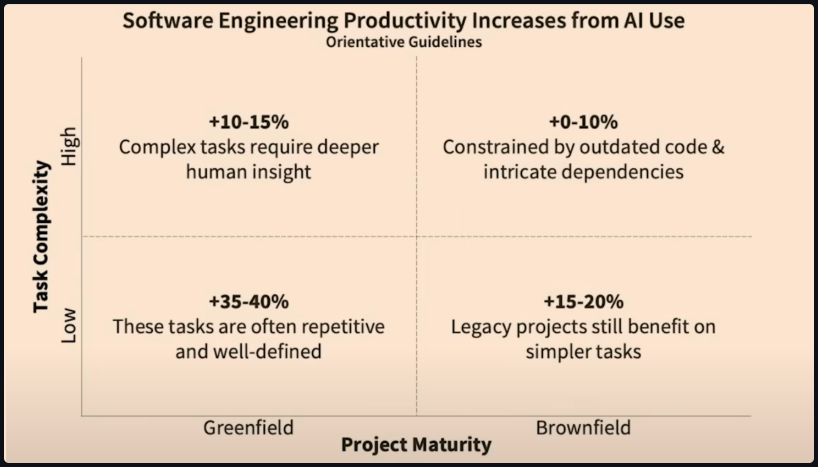
Greenfield projects gain 30-35% on simple tasks and
10-15% on complex ones, versus 15-20% and
5-10% in brownfield projects
source
Research also shows this is where many coding agents struggle.
The biggest challenge of AI coding today is not building greenfield products. It is modifying brownfield systems safely.
Slop Code
As AI coding became mainstream and Developers began generating huge amounts of code without fully understanding it, a new problem emerged that created:
- duplicated logic
- hidden bugs
- poor abstractions
- maintenance nightmares
This problem is what’s commonly called AI slop or code slop. Its the modern equivalent of «spaghetti code.»
LEVEL 9: Software Engineering Reality
These are challenges agents eventually run into.
Race Conditions
When two processes try to modify something simultaneously. A common source of bugs.
Shutdown Order
The sequence systems must stop services.
Get it wrong, and you get data corruption, failures, and outages.
Many agent-generated systems initially struggle with these operational details.
LEVEL 10: Autonomous Software Workers
OpenClaw
Open-source autonomous agent platform created by Peter Steinberger.
An agent that can:
- run continuously
- use tools
- message humans
- maintain memory
- operate through Telegram, WhatsApp, Discord, Slack
Finally
To conclude, I hope that our lists provided the clarity needed to navigate these topics.
The key takeaway here is the move away from prompt to context engineering.
The companies generating the most value from AI today are more often than not the ones building the best context systems.
Not the ones building the most sophisticated agents.
We hope that this guide helps you navigate your thoughts on outsourcing so that when you do decide, you may reach out to us in the form below.
Next: SpaceX IPO and Its Implications for AI and the Silicon Valley Ecosystem