

Perhaps the most defining event of 2026 began a month ago, when several currently available and upcoming language models began making headway on a number of open mathematical problems, ultimately culminating in a call by experts for tight guardrails around AI in mathematical research and sparking interesting debates online.
In total cumulative terms, the number of problems solved so far have been open for more than 300 years, and these include:
- The 87-year-old Jacobian Conjecture that Claude Fable 5 found a counterexample to, and
- The 10 open math problems OpenAI’s upcoming ‘Astra’ solved, as well as the Erdős Unit Distance Conjecture proof, which kickstarted the interest of research mathematicians in May and has been open for another 80 years.
Although some of the creators of these tools continue to agree that the math results and their implications may not be that much of a leap from what we’ve seen in the past, many argue that this new change in focus of AI from an automation tool to one to assist with discovery indicates an expanding range of problems it could solve.
For founders, this is an important shift to monitor.
«Invention, not automation, will be the greatest contribution of superintelligence.» —Mark.
And the defining question here, as proposed by Zuckerberg, is to ask: who will have access to the new intelligence that these models now provide, and what happens when it is directed towards your industry?
The Saturation Peak Ahead
While it’s almost stale to continue to repeat that ‘AI is getting smarter’, the increasingly credible demonstrations that AI systems can participate in scientific discovery naturally lead one to speculate that they may incentivize market disruption and saturation in dynamic ways. Think about it.
If a model can help identify a previously unknown mathematical counterexample, generate a new proof strategy, formulate a scientific hypothesis, and uncover a structure that researchers had not previously recognized, as is the case with many of the recent proofs, it should also be capable of producing new kinds of insights into business operations that may confer a specific edge. Preempting this capability in the hands of millions of people is helpful.
AI is breaking execution inertia. Reddit.
Currently, AI systems are already being used to build competing products, but as we proceed further into this shift in mindset towards discovery, nothing stops us from witnessing the kind of saturation we see emerging from the automation phase of the evolving AI timeline.
In fact, this is an inevitability that’s now getting the attention it needs in conversations about artificial intelligence, and this is far from stereotypical scaremongering.
This desire to move away from the era of generative AI technology where models primarily oversee workflows and do mundane work, I would argue, has long been coming.
Anthropic and other frontier labs’ pivot—amongst other frontier labs— into drug creation in search of its own business moat is, in our opinion, leading this line of thinking of models beyond mere coding assistant tools.
Put simply: in order for AI to indeed become the generational wealth and abundance creation tool everyone envisioned —including the labs and early adopters— it would first displace a lot of people’s ability to earn a living. When this peaks, and perhaps even before it does around the 2030s and at about ~95% of jobs involving screentime according to Anthropic’s projection, the deluge of effect I see all cumulate in what could be the death throes of still-viable businesses beyond a shrinking target market, and again, this is a worthy muse to begin to have about the future.
The Moat Moves from Execution to Insight
Furthermore, it is important to point out that the present concerns over the concentration of power with frontier AI labs that are perceived to be calling for regulatory capture resulting from imminent open-source catch-up are not unconnected to this discussion.
Furthermore, concerns about the concentration of power among frontier AI labs are not unrelated to this discussion. If open-source systems eventually catch up with frontier models, the question of who controls access to advanced intelligence could become as important as the question of who can use it.
And so is the conclusion that founders now need to prepare for the eventuality of a bite into their market share—whether by AI labs or the wider populace— by honing their insight-finding skills in the same way that the models now do.
Imagine two founders in 2028. Both have access to essentially the same model. Both can conduct research and prototype ideas in minutes. The fact that either founder can execute quickly is no longer particularly interesting, and their advantage is increasingly likely to have moved upstream.
For instance, questions like: which problem did they decide to solve and why did they recognise it? How? What did they understand about the customer that the model does not? What experiment did they run that everyone else overlooked? What new product category did they imagine? Are proving to be more crucial now than before.
Perhaps this is because every technological revolution seems to create the effect that it makes something so much easier to produce that the scarce resource moves elsewhere.
In the world of widespread AI where execution explodes, and production becomes less expensive, we expect a heavy premium placed on insight.
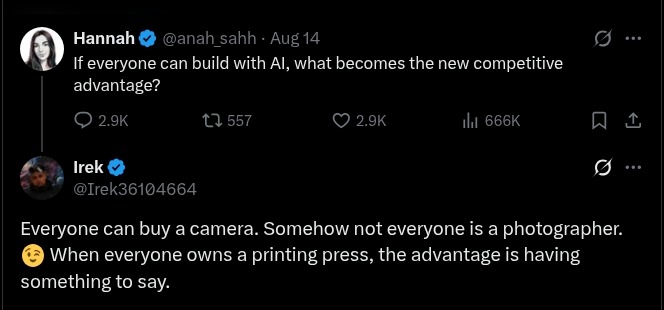
Founders are searching for answers to help survive the coming AI peak.
If millions of founders can ask AI systems to build websites, create apps, analyse a market, produce advertising creatives, generate sales emails and prepare a business plan, then all of these things ultimately become less valuable as sources of differentiation. For that, what you’ll need is precision.
Ultra-fine Insight Founders Win in a World of Cheap Execution
When the Industrial Revolution made the physical production of clothes cheaper with the invention of the cotton engine, weave patterns became a subject of study. The corollary here is simple.
The finer the detail of a founder’s insight into their business, the greater the potential value of that insight—and, ultimately, the moat it can create.
With the current trend, the founder’s job in a world where insight becomes the main competitive advantage is closer to a scientist’s job of observing, hypothesising, experimenting, and measuring.
That’s why this new shift in focus is important to note.
In their study in the Journal of the Knowledge Economy, authors Elpida Samara et al highlighted how Duolingo uses this principle in the context of rapid digital transformation and increasingly volatile consumer behavior as a way to build a competitive adaptive edge.
The company’s moat is increasingly being built around the understanding of human psychology and behavioural tendencies through experimentation to derive insights, and evidence of this can be seen in its app’s tradition.
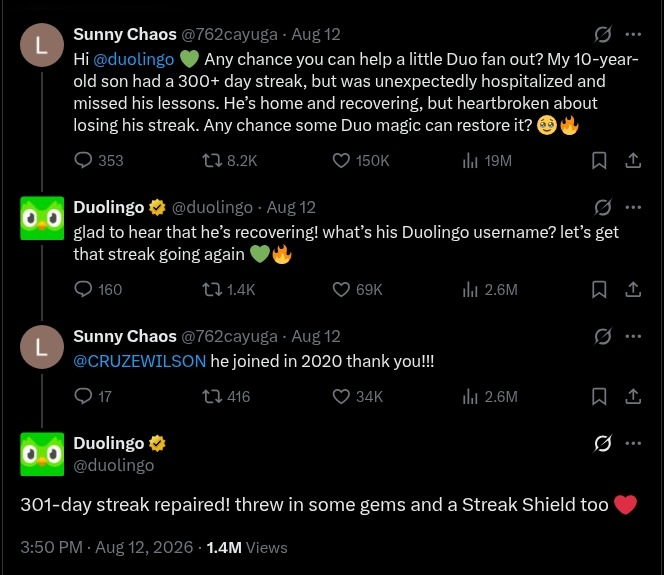
Duolingo has a long tradition that keeps its audiences loving it.
Beyond just gamification, the company used insight it derived from experimentation—for example, that overwhelming new users with choices spikes exit- an insight which influenced its move to a progressive disclosure model—to drive up retention rates.
Just as with the invention of the cotton picker leading to finer and finer clothes, the result of models being perhaps trained for insight discovery compresses the loop of the startup process.
What This All Means for Founders
Finally, even as the vision of AI labs moves toward increasingly ambitious forms of machine intelligence, and models compete to outdo one another in novel discoveries, an immense opportunity is emerging for founders.
Moreover, the specific human knowledge that becomes increasingly valuable in this future may be the understanding of context that great founders already possess.
Before the pivot toward discovery, we talked about how founders with native workflows particularly benefited from the automation AI provides. In a world where AI-assisted discovery becomes widespread, that advantage may become much harder to preserve.
In the Zuckerberg essay referenced earlier, he argues that the greatest contribution of superintelligence will be invention rather than automation, predicting that broadly distributed advanced AI could make it significantly easier for people to start businesses and pursue new ideas; we agree.
Although the concerns about inequality of compute may hinder this vision, as suggested by Sholto, we nevertheless think this future —of distributed advanced discovery intelligence— is one founders should nonetheless look forward to even as we marvel at some of the biggest breakthroughs in AI right now.
Read more articles like this one on our blog to get insights about businesses, technology, and how we engineer some other interesting projects of choice.